Small Bathroom Storage Ideas for Everyday Essentials
In a compact home, small bathroom storage ideas for everyday essentials is as much about preserving movement as it is about finding more storage. Every added shelf, basket, chair, or cabinet uses visual and physical space, so the best solution is not always the one that holds the most. Start by protecting the main walking route and the surfaces needed for everyday activities, then decide which belongings deserve the easiest access. Vertical and hidden storage can help, but only when it reduces pressure on the floor and counters rather than making the room feel busier. The ideas below focus on proportion, accessibility, and breathing room so the space can feel functional without becoming overfilled.
Keep Daily Items Close to the Sink
Approach keeping daily items close to the sink by protecting movement first, then adding only the storage or furniture that earns its footprint. A solution that holds more spray bottles is not automatically better if it blocks access to sponges or narrows the main walking route. Choose one well-proportioned piece or storage zone instead of several tiny additions that fragment the room—a useful distinction when keeping daily items close to the sink. Live with the arrangement for several days and notice where spray bottles still lands, where movement feels tight, and which storage remains unused. The best small-space solution is the one you can use without rearranging something else first—a useful distinction when keeping daily items close to the sink.
Use Wall Space Without Filling Every Surface
Approach using wall space without filling every surface by protecting movement first, then adding only the storage or furniture that earns its footprint. The most useful storage is usually the one that frees a working surface or keeps toiletries off the floor without creating another obstacle. Keep toiletries in the easiest zone, group skincare tightly, and move occasional towels higher, lower, or into hidden storage. Seasonal changes are a good time to rotate low-frequency belongings so prime storage stays available for what is used now—a useful distinction when using wall space without filling every surface. The best small-space solution is the one you can use without rearranging something else first—a useful distinction when using wall space without filling every surface. For a broader system that complements this step, see Small Apartment Storage Ideas That Do Not Require Renovation, which adds useful context without changing the basic routine.
Choose Shallow Storage for Tight Areas
Approach choosing shallow storage for tight areas by protecting movement first, then adding only the storage or furniture that earns its footprint. Categories such as toiletries, skincare, and towels can overwhelm a compact room quickly because there is little spare surface or floor area to absorb overflow. Use vertical or concealed capacity where it solves a defined problem, but preserve some blank wall and open floor so the room still feels calm—a useful distinction when choosing shallow storage for tight areas. Keep category limits visible. When toiletries or skincare exceeds its shelf or basket, review the contents before adding more capacity. Once the room feels easier to move through and easier to reset, extra storage is usually less urgent than it first appeared—a useful distinction when choosing shallow storage for tight areas.
Make Use of the Area Above the Toilet Carefully
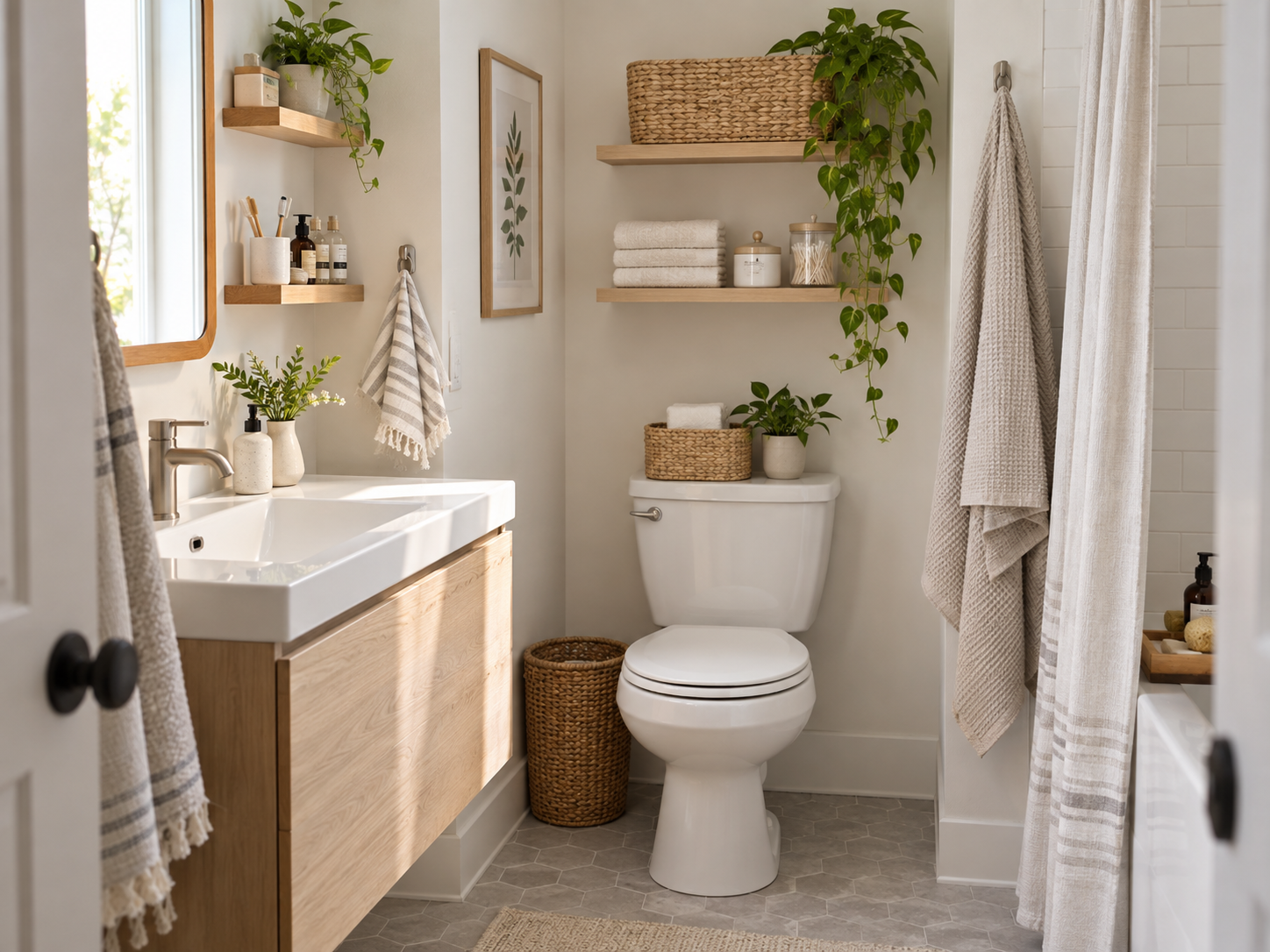
Approach making use of the area above the toilet carefully by protecting movement first, then adding only the storage or furniture that earns its footprint. The most useful storage is usually the one that frees a working surface or keeps toiletries off the floor without creating another obstacle—a useful distinction when making use of the area above the toilet carefully. Keep toiletries in the easiest zone, group skincare tightly, and move occasional towels higher, lower, or into hidden storage—a useful distinction when making use of the area above the toilet carefully. Seasonal changes are a good time to rotate low-frequency belongings so prime storage stays available for what is used now—a useful distinction when making use of the area above the toilet carefully. When making use of the area above the toilet carefully preserves movement and reduces visual competition, the room feels larger even though its dimensions have not changed.
Control Backstock and Extra Toiletries
Controlling backstock and extra toiletries is most successful when it creates capacity and still leaves the eye somewhere to rest. A solution that holds more toiletries is not automatically better if it blocks access to skincare or narrows the main walking route. Keep toiletries in the easiest zone, group skincare tightly, and move occasional towels higher, lower, or into hidden storage—a useful distinction when controlling backstock and extra toiletries. Seasonal changes are a good time to rotate low-frequency belongings so prime storage stays available for what is used now—a useful distinction when controlling backstock and extra toiletries. When controlling backstock and extra toiletries preserves movement and reduces visual competition, the room feels larger even though its dimensions have not changed.
Use Hooks for Towels and Frequently Used Items
Approach using hooks for towels and frequently used items by protecting movement first, then adding only the storage or furniture that earns its footprint. The most useful storage is usually the one that frees a working surface or keeps toiletries off the floor without creating another obstacle—a useful distinction when using hooks for towels and frequently used items. Use vertical or concealed capacity where it solves a defined problem, but preserve some blank wall and open floor so the room still feels calm—a useful distinction when using hooks for towels and frequently used items. Use light, mirrors, and repeated materials as supporting tools, but do not rely on décor tricks to compensate for furniture that is simply too large—a useful distinction when using hooks for towels and frequently used items. When toiletries or skincare exceeds its shelf or basket, review the contents before adding more capacity—a useful distinction when using hooks for towels and frequently used items. Protecting a little empty capacity is part of the design; it gives the home room to absorb normal daily activity—a useful distinction when using hooks for towels and frequently used items. If you want to extend this idea to another part of the home, 15 Smart Storage Ideas for Small Spaces offers a practical next reference.
Hide Visually Busy Categories
Hide visually busy categories is most successful when it creates capacity and still leaves the eye somewhere to rest. The most useful storage is usually the one that frees a working surface or keeps toiletries off the floor without creating another obstacle—a useful distinction when hide Visually Busy Categories. Use vertical or concealed capacity where it solves a defined problem, but preserve some blank wall and open floor so the room still feels calm—a useful distinction when hide Visually Busy Categories. Live with the arrangement for several days and notice where toiletries still lands, where movement feels tight, and which storage remains unused. Once the room feels easier to move through and easier to reset, extra storage is usually less urgent than it first appeared—a useful distinction when hide Visually Busy Categories.
Keep the Floor as Clear as Possible
Keeping the floor as clear as possible matters in a compact home because every piece of floor, wall, and storage space affects how the room feels to use. Visual clutter often comes from many small storage pieces, exposed toiletries, and furniture that interrupts sightlines rather than from square footage alone. Keep toiletries in the easiest zone, group skincare tightly, and move occasional towels higher, lower, or into hidden storage—a useful distinction when keeping the floor as clear as possible. Keep category limits visible. When toiletries or skincare exceeds its shelf or basket, review the contents before adding more capacity—a useful distinction when keeping the floor as clear as possible. The best small-space solution is the one you can use without rearranging something else first—a useful distinction when keeping the floor as clear as possible.
Conclusion
For small bathroom storage ideas for everyday essentials, the most valuable resource is not another container; it is usable space. Protect walking paths, keep everyday belongings in accessible zones, and use vertical or hidden storage only when it solves a defined problem—a useful distinction when small bathroom storage ideas for everyday essentials. Furniture and organizers should earn their footprint by supporting a real activity, not simply by offering more capacity—a useful distinction when small bathroom storage ideas for everyday essentials. Leave some shelves, drawers, or surfaces partly open so the home can absorb groceries, laundry, guests, and changing routines—a useful distinction when small bathroom storage ideas for everyday essentials. When the room is easy to move through and quick to reset, it will feel more spacious even though the square footage has not changed—a useful distinction when small bathroom storage ideas for everyday essentials.