How to Organize Household Supplies Without Overbuying
Good organization is less about how many containers a home has and more about how clearly the space supports daily life—a useful distinction when organizing household supplies without overbuying. With organizing household supplies without overbuying, the strongest improvements often come from moving one category closer to where it is used, reducing what no longer earns prime storage, or simplifying a routine that keeps breaking down. The goal is a home that can recover after being busy rather than a home that never looks lived in—a useful distinction when organizing household supplies without overbuying. Use the sections below as a practical framework—a useful distinction when organizing household supplies without overbuying. Measure before buying, pay attention to recurring drop points, and judge every system by how easy it is to use when you are tired, distracted, or in a hurry—a useful distinction when organizing household supplies without overbuying.
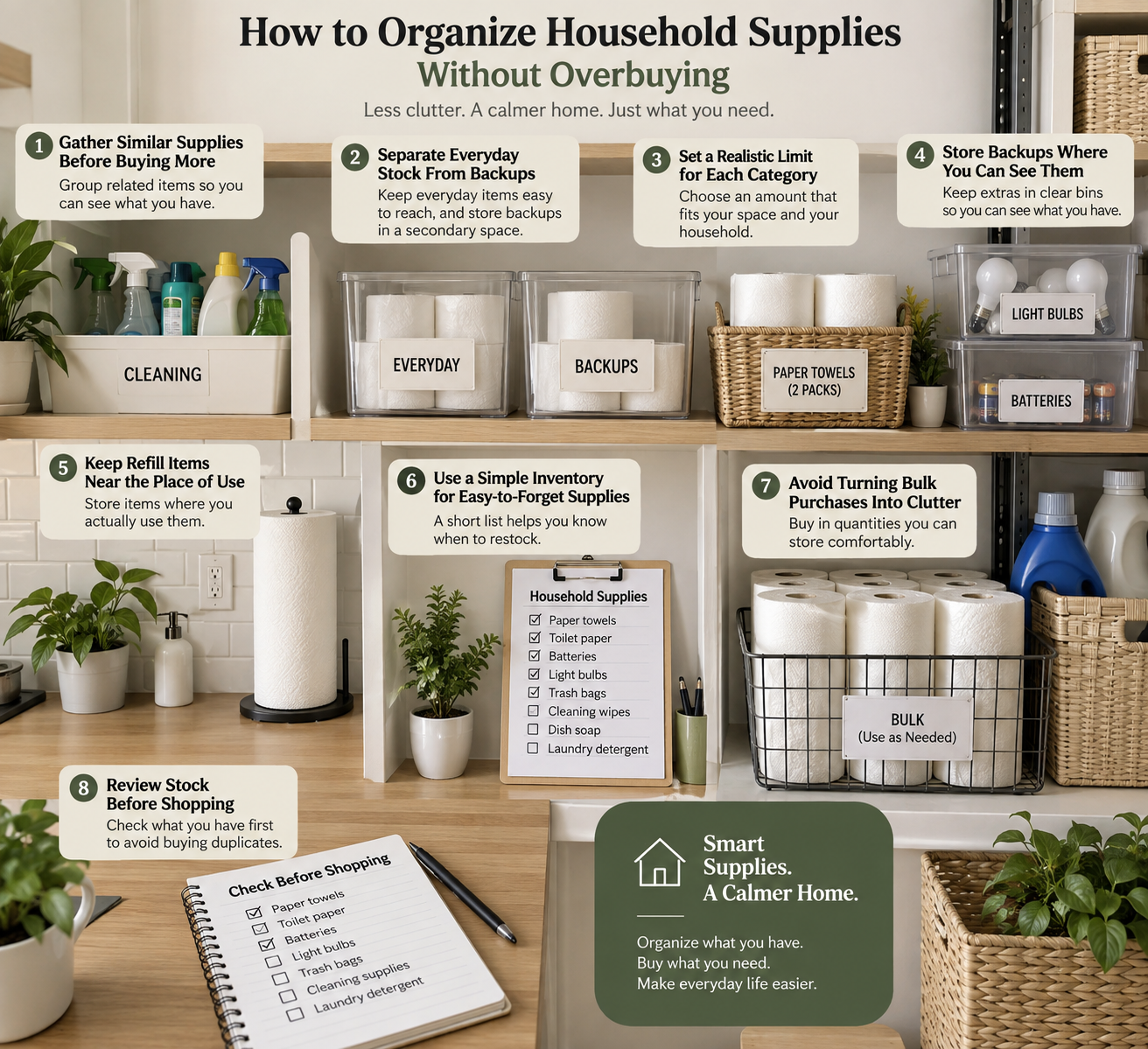
Gather Similar Supplies Before Buying More
Think of gathering similar supplies before buying more as a way to remove one repeated decision from the day. The trouble often shows up around paper towels and batteries because those categories move in and out of the room several times a day. Group related items, keep paper towels near the point of use, and move backup or low-frequency light bulbs out of prime space. Review the zone when it starts overflowing rather than waiting for a full-house decluttering session—a useful distinction when gathering similar supplies before buying more. A system that survives rushed mornings and tired evenings is more valuable than one that looks perfect only after a major reset—a useful distinction when gathering similar supplies before buying more.
Separate Everyday Stock From Backups
Think of separating everyday stock from backups as a way to remove one repeated decision from the day. High-use categories like paper towels deserve the easiest access, while occasional light bulbs can live in secondary storage. Decide the category limit before choosing a container so the organizer supports the amount you need rather than encouraging overflow—a useful distinction when separating everyday stock from backups. Watch where paper towels lands during the next week; repeated drop points are useful clues about where its permanent home should be. When separating everyday stock from backups becomes easy to repeat, the space can recover from ordinary mess without constant tidying. For a broader system that complements this step, see How to Create a Functional Drop Zone for Keys, Bags, and Mail, which adds useful context without changing the basic routine.
Set a Realistic Limit for Each Category
Think of setting a realistic limit for each category as a way to remove one repeated decision from the day. High-use categories like paper towels deserve the easiest access, while occasional light bulbs can live in secondary storage—a useful distinction when setting a realistic limit for each category. Decide the category limit before choosing a container so the organizer supports the amount you need rather than encouraging overflow—a useful distinction when setting a realistic limit for each category. Watch where paper towels lands during the next week; repeated drop points are useful clues about where its permanent home should be—a useful distinction when setting a realistic limit for each category. When setting a realistic limit for each category becomes easy to repeat, the space can recover from ordinary mess without constant tidying.
Store Backups Where You Can See Them
Think of storing backups where you can see them as a way to remove one repeated decision from the day. An overfilled zone makes even simple tasks harder because paper towels must compete with batteries for the same convenient space. Clear the area, return only what belongs there, and give paper towels and batteries separate, easy-to-read boundaries. Watch where paper towels lands during the next week; repeated drop points are useful clues about where its permanent home should be—a useful distinction when storing backups where you can see them. The test is simple: after a busy day, the area should be able to return to baseline without a long sorting session—a useful distinction when storing backups where you can see them.
Keep Refill Items Near the Place of Use
Think of keeping refill items near the place of use as a way to remove one repeated decision from the day. The trouble often shows up around paper towels and batteries because those categories move in and out of the room several times a day—a useful distinction when keeping refill items near the place of use. Clear the area, return only what belongs there, and give paper towels and batteries separate, easy-to-read boundaries—a useful distinction when keeping refill items near the place of use. Small adjustments are enough: move one category, reduce one excess group, or remove one unnecessary step and see whether the change sticks—a useful distinction when keeping refill items near the place of use. A system that survives rushed mornings and tired evenings is more valuable than one that looks perfect only after a major reset—a useful distinction when keeping refill items near the place of use.
Use a Simple Inventory for Easy-to-Forget Supplies
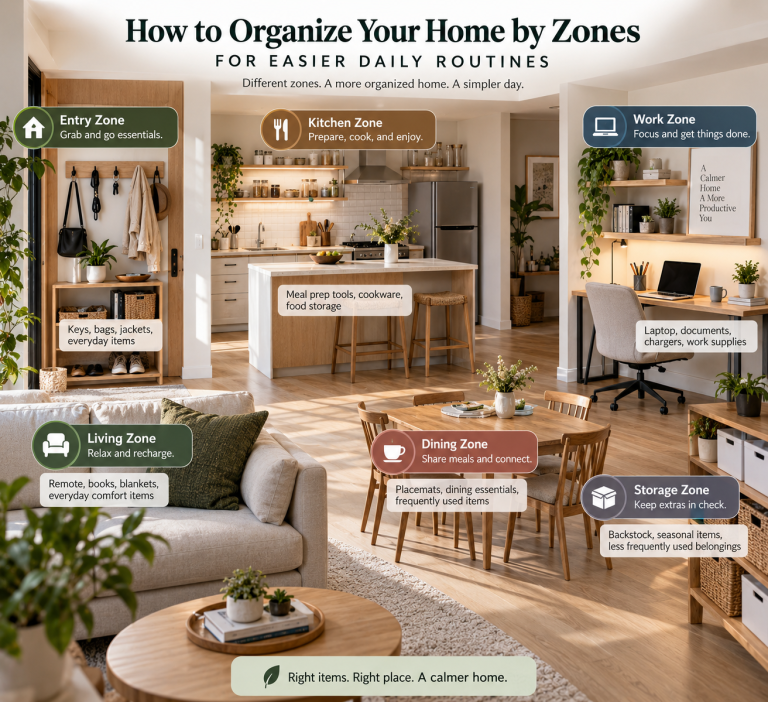
Using a simple inventory for easy-to-forget supplies should reduce friction rather than create another standard everyone has to remember. High-use categories like paper towels deserve the easiest access, while occasional light bulbs can live in secondary storage—a useful distinction when using a simple inventory for easy-to-forget supplies. Decide the category limit before choosing a container so the organizer supports the amount you need rather than encouraging overflow—a useful distinction when using a simple inventory for easy-to-forget supplies. Watch where paper towels lands during the next week; repeated drop points are useful clues about where its permanent home should be—a useful distinction when using a simple inventory for easy-to-forget supplies. A system that survives rushed mornings and tired evenings is more valuable than one that looks perfect only after a major reset—a useful distinction when using a simple inventory for easy-to-forget supplies. If you want to extend this idea to another part of the home, How to Organize Your Home by Zones for Easier Daily Routines offers a practical next reference.
Avoid Turning Bulk Purchases Into Clutter
Avoiding turning bulk purchases into clutter should reduce friction rather than create another standard everyone has to remember. An overfilled zone makes even simple tasks harder because paper towels must compete with batteries for the same convenient space—a useful distinction when avoiding turning bulk purchases into clutter. Decide the category limit before choosing a container so the organizer supports the amount you need rather than encouraging overflow—a useful distinction when avoiding turning bulk purchases into clutter. Watch where paper towels lands during the next week; repeated drop points are useful clues about where its permanent home should be—a useful distinction when avoiding turning bulk purchases into clutter. Once this part feels automatic, leave it alone and improve the next friction point instead of reorganizing what already works—a useful distinction when avoiding turning bulk purchases into clutter.
Review Stock Before Shopping
Think of reviewing stock before shopping as a way to remove one repeated decision from the day. The trouble often shows up around paper towels and batteries because those categories move in and out of the room several times a day—a useful distinction when reviewing stock before shopping. Group related items, keep paper towels near the point of use, and move backup or low-frequency light bulbs out of prime space—a useful distinction when reviewing stock before shopping. A quick reset should take only a few minutes—a useful distinction when reviewing stock before shopping. If it does not, simplify the category or move it closer to the activity it supports—a useful distinction when reviewing stock before shopping. Once this part feels automatic, leave it alone and improve the next friction point instead of reorganizing what already works—a useful distinction when reviewing stock before shopping.
Conclusion
Organizing household supplies without overbuying is successful when the system keeps working after the room has been used, not just when the project is finished. Keep frequent items convenient, give expanding categories clear limits, and leave enough breathing room that normal activity does not immediately create overflow—a useful distinction when organizing household supplies without overbuying. If the same pile or delay returns, treat it as feedback about placement or capacity rather than a reason to tidy harder—a useful distinction when organizing household supplies without overbuying. Small adjustments made from real use are usually more durable than a complete redesign—a useful distinction when organizing household supplies without overbuying. Over time, a collection of easy-to-follow systems creates a home that feels calmer because returning to baseline takes minutes instead of another organizing session—a useful distinction when organizing household supplies without overbuying.