
How to Organize a Busy Family Home Without Constant Tidying
Organizing organizing a busy family home without constant tidying is easier when the goal is not to keep everything perfectly in place, but to make everyday decisions simpler. Clutter usually builds where belongings do not have a convenient home, where storage is packed too tightly, or where a routine asks for more steps than people will follow on a busy day. A practical system should help you find what you need, return it quickly, and notice when a category is beginning to overflow. The approach below focuses on realistic placement, clear boundaries, and short resets rather than elaborate containers or showroom-style organization. Start with the area that creates the most friction, test the change during normal life, and keep only the systems that actually make the household easier to run.
Define What Organized Means for Your Household
Think of defining what organized means for your household as a way to remove one repeated decision from the day. High-use categories like backpacks deserve the easiest access, while occasional school papers can live in secondary storage. Start with storage you already own: one shelf, tray, hook, drawer, or basket can test whether the new location is genuinely convenient. A quick reset should take only a few minutes. If it does not, simplify the category or move it closer to the activity it supports. When defining what organized means for your household becomes easy to repeat, the space can recover from ordinary mess without constant tidying.
Start With the Busiest Shared Zones
Starting with the busiest shared zones works best when the location or rule matches what people already do in the space. High-use categories like backpacks deserve the easiest access, while occasional school papers can live in secondary storage—a useful distinction when starting with the busiest shared zones. Start with storage you already own: one shelf, tray, hook, drawer, or basket can test whether the new location is genuinely convenient—a useful distinction when starting with the busiest shared zones. Small adjustments are enough: move one category, reduce one excess group, or remove one unnecessary step and see whether the change sticks. When starting with the busiest shared zones becomes easy to repeat, the space can recover from ordinary mess without constant tidying. If you want to extend this idea to another part of the home, How to Create an Organized Home That Is Easy to Maintain offers a practical next reference.
Create Easy Homes for Everyday Belongings
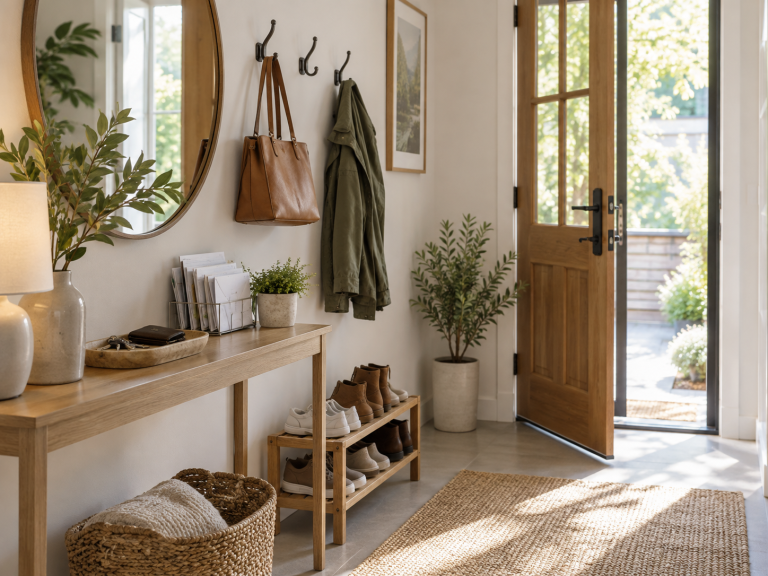
Creating easy homes for everyday belongings should reduce friction rather than create another standard everyone has to remember. The trouble often shows up around backpacks and lunch boxes because those categories move in and out of the room several times a day. Group related items, keep backpacks near the point of use, and move backup or low-frequency school papers out of prime space. A quick reset should take only a few minutes—a useful distinction when creating easy homes for everyday belongings. If it does not, simplify the category or move it closer to the activity it supports—a useful distinction when creating easy homes for everyday belongings. The test is simple: after a busy day, the area should be able to return to baseline without a long sorting session.
Use Open Storage for Fast Return
Using open storage for fast return should reduce friction rather than create another standard everyone has to remember. High-use categories like backpacks deserve the easiest access, while occasional school papers can live in secondary storage—a useful distinction when using open storage for fast return. Clear the area, return only what belongs there, and give backpacks and lunch boxes separate, easy-to-read boundaries. Small adjustments are enough: move one category, reduce one excess group, or remove one unnecessary step and see whether the change sticks—a useful distinction when using open storage for fast return. The test is simple: after a busy day, the area should be able to return to baseline without a long sorting session—a useful distinction when using open storage for fast return.
Build a Practical Paper and Schoolwork System
Building a practical paper and schoolwork system works best when the location or rule matches what people already do in the space. High-use categories like backpacks deserve the easiest access, while occasional school papers can live in secondary storage—a useful distinction when building a practical paper and schoolwork system. Group related items, keep backpacks near the point of use, and move backup or low-frequency school papers out of prime space—a useful distinction when building a practical paper and schoolwork system. Watch where backpacks lands during the next week; repeated drop points are useful clues about where its permanent home should be. A system that survives rushed mornings and tired evenings is more valuable than one that looks perfect only after a major reset.
Reduce Duplicate Household Supplies
The practical goal of reducing duplicate household supplies is to make the next action obvious, even when the household is busy. The trouble often shows up around backpacks and lunch boxes because those categories move in and out of the room several times a day—a useful distinction when reducing duplicate household supplies. Clear the area, return only what belongs there, and give backpacks and lunch boxes separate, easy-to-read boundaries—a useful distinction when reducing duplicate household supplies. Watch where backpacks lands during the next week; repeated drop points are useful clues about where its permanent home should be—a useful distinction when reducing duplicate household supplies. The test is simple: after a busy day, the area should be able to return to baseline without a long sorting session—a useful distinction when reducing duplicate household supplies. This step also connects naturally with Best Home Organization Ideas for a Calm and Clutter-Free Space, especially if the same friction appears in more than one room.
Use Short Resets at Natural Transition Times
The practical goal of using short resets at natural transition times is to make the next action obvious, even when the household is busy. High-use categories like backpacks deserve the easiest access, while occasional school papers can live in secondary storage—a useful distinction when using short resets at natural transition times. Group related items, keep backpacks near the point of use, and move backup or low-frequency school papers out of prime space—a useful distinction when using short resets at natural transition times. If the area is compact, prioritize the items handled daily and let less frequent belongings use higher, deeper, or less convenient storage—a useful distinction when using short resets at natural transition times. A quick reset should take only a few minutes—a useful distinction when using short resets at natural transition times. If it does not, simplify the category or move it closer to the activity it supports—a useful distinction when using short resets at natural transition times. Once this part feels automatic, leave it alone and improve the next friction point instead of reorganizing what already works.
Review Systems When Clutter Keeps Returning
Reviewing systems when clutter keeps returning should reduce friction rather than create another standard everyone has to remember. High-use categories like backpacks deserve the easiest access, while occasional school papers can live in secondary storage—a useful distinction when reviewing systems when clutter keeps returning. Start with storage you already own: one shelf, tray, hook, drawer, or basket can test whether the new location is genuinely convenient—a useful distinction when reviewing systems when clutter keeps returning. Do not add another piece of furniture just to gain capacity unless the existing category has already been edited and measured—a useful distinction when reviewing systems when clutter keeps returning. Watch where backpacks lands during the next week; repeated drop points are useful clues about where its permanent home should be—a useful distinction when reviewing systems when clutter keeps returning. When reviewing systems when clutter keeps returning becomes easy to repeat, the space can recover from ordinary mess without constant tidying.
Conclusion
Organizing a busy family home without constant tidying is successful when the system keeps working after the room has been used, not just when the project is finished. Keep frequent items convenient, give expanding categories clear limits, and leave enough breathing room that normal activity does not immediately create overflow. If the same pile or delay returns, treat it as feedback about placement or capacity rather than a reason to tidy harder. Small adjustments made from real use are usually more durable than a complete redesign. Over time, a collection of easy-to-follow systems creates a home that feels calmer because returning to baseline takes minutes instead of another organizing session.