Simple Entryway Organization Ideas for a Clutter-Free Welcome
Good organization is less about how many containers a home has and more about how clearly the space supports daily life. With simple entryway organization ideas for a clutter-free welcome, the strongest improvements often come from moving one category closer to where it is used, reducing what no longer earns prime storage, or simplifying a routine that keeps breaking down. The goal is a home that can recover after being busy rather than a home that never looks lived in. Use the sections below as a practical framework. Measure before buying, pay attention to recurring drop points, and judge every system by how easy it is to use when you are tired, distracted, or in a hurry.
Decide What the Entryway Really Needs to Hold
Deciding what the entryway really needs to hold should reduce friction rather than create another standard everyone has to remember. Items such as keys, shoes, and bags usually become clutter when their storage is farther away than the place where they are used. Start with storage you already own: one shelf, tray, hook, drawer, or basket can test whether the new location is genuinely convenient—a useful distinction when deciding what the entryway really needs to hold. Watch where keys lands during the next week; repeated drop points are useful clues about where its permanent home should be. Once this part feels automatic, leave it alone and improve the next friction point instead of reorganizing what already works—a useful distinction when deciding what the entryway really needs to hold.
Create a Landing Spot for Keys and Wallets
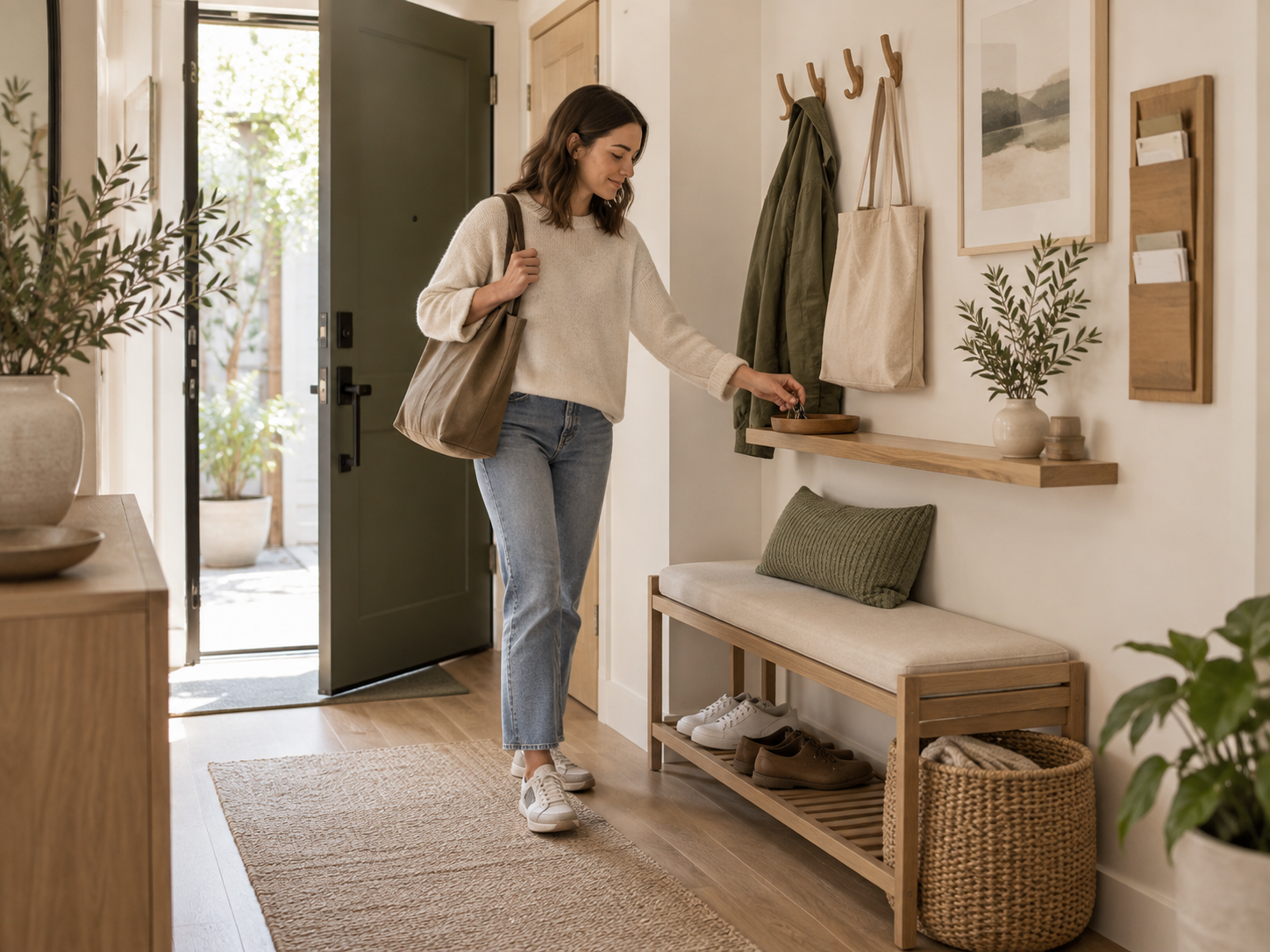
Creating a landing spot for keys and wallets works best when the location or rule matches what people already do in the space. High-use categories like keys deserve the easiest access, while occasional bags can live in secondary storage. Clear the area, return only what belongs there, and give keys and shoes separate, easy-to-read boundaries. Small adjustments are enough: move one category, reduce one excess group, or remove one unnecessary step and see whether the change sticks—a useful distinction when creating a landing spot for keys and wallets. When creating a landing spot for keys and wallets becomes easy to repeat, the space can recover from ordinary mess without constant tidying. This step also connects naturally with Best Home Organization Ideas for a Calm and Clutter-Free Space, especially if the same friction appears in more than one room—a useful distinction when creating a landing spot for keys and wallets.
Give Bags and Jackets an Easy Home
Giving bags and jackets an easy home works best when the location or rule matches what people already do in the space. An overfilled zone makes even simple tasks harder because keys must compete with shoes for the same convenient space. Group related items, keep keys near the point of use, and move backup or low-frequency bags out of prime space. A quick reset should take only a few minutes—a useful distinction when giving bags and jackets an easy home. If it does not, simplify the category or move it closer to the activity it supports—a useful distinction when giving bags and jackets an easy home. When giving bags and jackets an easy home becomes easy to repeat, the space can recover from ordinary mess without constant tidying.
Control Shoes Without Filling the Floor
Think of controlling shoes without filling the floor as a way to remove one repeated decision from the day. An overfilled zone makes even simple tasks harder because keys must compete with shoes for the same convenient space—a useful distinction when controlling shoes without filling the floor. Start with storage you already own: one shelf, tray, hook, drawer, or basket can test whether the new location is genuinely convenient—a useful distinction when controlling shoes without filling the floor. Small adjustments are enough: move one category, reduce one excess group, or remove one unnecessary step and see whether the change sticks—a useful distinction when controlling shoes without filling the floor. A system that survives rushed mornings and tired evenings is more valuable than one that looks perfect only after a major reset—a useful distinction when controlling shoes without filling the floor.
Handle Mail Before It Spreads
Think of handling mail before it spreads as a way to remove one repeated decision from the day. High-use categories like keys deserve the easiest access, while occasional bags can live in secondary storage—a useful distinction when handling mail before it spreads. Clear the area, return only what belongs there, and give keys and shoes separate, easy-to-read boundaries—a useful distinction when handling mail before it spreads. A quick reset should take only a few minutes—a useful distinction when handling mail before it spreads. If it does not, simplify the category or move it closer to the activity it supports—a useful distinction when handling mail before it spreads. A system that survives rushed mornings and tired evenings is more valuable than one that looks perfect only after a major reset—a useful distinction when handling mail before it spreads.
Use Vertical Space Carefully
The practical goal of using vertical space carefully is to make the next action obvious, even when the household is busy. The trouble often shows up around keys and shoes because those categories move in and out of the room several times a day. Group related items, keep keys near the point of use, and move backup or low-frequency bags out of prime space—a useful distinction when using vertical space carefully. Watch where keys lands during the next week; repeated drop points are useful clues about where its permanent home should be—a useful distinction when using vertical space carefully. The test is simple: after a busy day, the area should be able to return to baseline without a long sorting session—a useful distinction when using vertical space carefully. For related examples and a wider organizing framework, read How to Declutter Your Home Room by Room after you have tested this setup in daily use.
Keep Seasonal Gear From Taking Over
Keeping seasonal gear from taking over works best when the location or rule matches what people already do in the space. Items such as keys, shoes, and bags usually become clutter when their storage is farther away than the place where they are used—a useful distinction when keeping seasonal gear from taking over. Group related items, keep keys near the point of use, and move backup or low-frequency bags out of prime space—a useful distinction when keeping seasonal gear from taking over. If the setup looks tidy but requires moving several things to reach shoes, it is too dense for everyday use—a useful distinction when keeping seasonal gear from taking over. Review the zone when it starts overflowing rather than waiting for a full-house decluttering session. The test is simple: after a busy day, the area should be able to return to baseline without a long sorting session—a useful distinction when keeping seasonal gear from taking over.
Reset the Entryway in Two Minutes
Resetting the entryway in two minutes works best when the location or rule matches what people already do in the space. High-use categories like keys deserve the easiest access, while occasional bags can live in secondary storage—a useful distinction when resetting the entryway in two minutes. Clear the area, return only what belongs there, and give keys and shoes separate, easy-to-read boundaries—a useful distinction when resetting the entryway in two minutes. If the setup looks tidy but requires moving several things to reach shoes, it is too dense for everyday use—a useful distinction when resetting the entryway in two minutes. Watch where keys lands during the next week; repeated drop points are useful clues about where its permanent home should be—a useful distinction when resetting the entryway in two minutes. A system that survives rushed mornings and tired evenings is more valuable than one that looks perfect only after a major reset—a useful distinction when resetting the entryway in two minutes.
Conclusion
The best way to maintain simple entryway organization ideas for a clutter-free welcome is to make the correct action the easy action. Storage should be understandable, accessible, and loose enough to absorb normal change. Review categories when they overflow, move homes that are repeatedly ignored, and resist adding complexity to a system that already works. A functional home will still become temporarily messy, especially during busy days. What matters is that the mess has somewhere to go and that a short reset can restore the space without a long series of decisions. That is a more useful definition of organization than perfection.